Blacklight Resumes · flagship field brief
The Blacklight Partner Field Brief
A practical partnership model for accountable resume support across workforce and community programs.
Blacklight gives workforce and community programs a consistent resume-support service they can offer participants without building every step themselves.
What this brief is for
Use the field brief when the first question has moved from “what is Blacklight?” to “could this work inside our program?” It explains the problem, how the partner program works, and what a pilot could look like without requiring a live walkthrough first.
Who should recognize themselves here
The operating problem
Resume support often starts with good intent and weak infrastructure. A participant asks for help, a staff member does what they can, and the organization is left trying to remember what happened across inboxes, spreadsheets, and one-off follow-up.
- Resume help often starts as ad hoc support instead of a consistent service.
- Participants need a clearer path than a generic form and a vague wait.
- Frontline staff should not have to rebuild the process from inbox memory.
- Program leaders need a story they can explain internally without stitching together spreadsheets and screenshots.
The partnership opportunity
Blacklight gives a program a consistent resume-support service without asking the partner to build requests, status updates, delivery, support, and reporting from scratch. The opportunity is practical: a clearer participant experience, clearer staff responsibilities, and a program story that can survive internal review.
- Partners can offer a more credible service without inventing every step locally.
- Participants get a guided path and clearer status visibility.
- Frontline staff get clearer responsibilities and less manual reconstruction.
- Program leaders get a more legible program story for review, renewal, and rollout planning.
What Blacklight provides
Blacklight provides the pieces that make resume support easier to run: a guided request, resume and cover-letter support, status updates, delivery, reporting, and clear support contacts. The point is not another form. The point is a consistent service a partner can explain.
- Hosted or referred intake that stays structured instead of becoming a local workaround.
- Resume and cover-letter support delivered through one consistent process.
- Status visibility and delivery follow-up that stay attached to the request.
- Partner-facing reporting and exports that make oversight easier.
- Staff access based on role, with separate contacts for support and trust questions.
How the program works
The process is simple enough to explain: a participant starts through a hosted page or referral, Blacklight collects the details needed for the request, the work is processed and reviewed, delivery stays tied to status, and partner reporting shows overall program activity.
- Referrals and hosted request forms can both lead into the same process.
- Processing, delivery, and status stay visible enough to explain what happens after intake.
- Support and factual-correction follow-up stay with the request instead of falling back to loose email threads.
- Partner reporting turns activity into a reviewable program view instead of an anecdotal one.
What each stakeholder gets
A useful partner program has to work for more than one reader. Participants need a clear next step. Frontline staff need a process they can trust. Program leaders need visibility. Operations owners need responsibilities that do not depend on institutional memory.
- Participants get a guided path and stronger delivery confidence.
- Frontline staff get clearer referral and support boundaries.
- Program leaders get reporting visibility and rollout clarity.
- Operations and admin owners get a maintainable process with role-based access and a clear history of updates.
Partner use cases
The same service can support workforce programs, libraries, colleges, nonprofits, training providers, and specialized support organizations because they share a practical need: people need resume help and teams need a clearer way to provide it.
- The core service stays the same even when the audience changes.
- Hosted intake and partner reporting adapt to different program settings.
- Later partner-type briefs can deepen the framing for each audience.
- Use cases should show possible fit, not imply existing customers.
Product examples
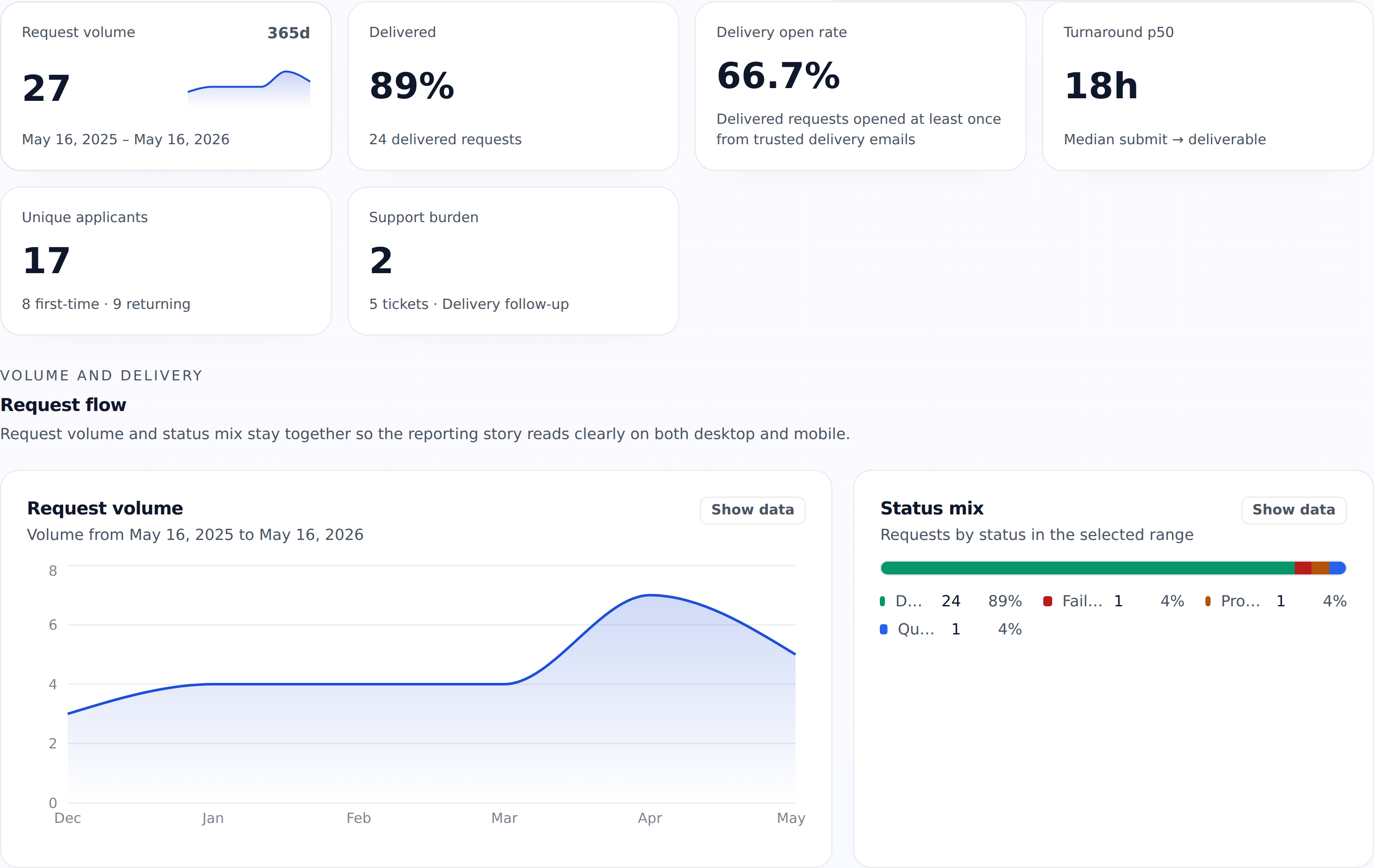
Real product screenshots show how requests and reporting work without turning this brief into a technical manual.

Program features
- Hosted intake and embeds: Run the service from a hosted partner page, an iframe embed, or both depending on how your organization wants to launch.
- Locations and staff access: Manage multiple branches, campuses, or sites with scoped staff access. Account leadership can keep local capacity changes admin-only, require approval for increases, or delegate approved preset changes. Location managers stay limited to assigned locations and the account-wide cap, and applied changes preserve a reviewable history.
- Reporting and exports: Download partner-facing reports that show people served, location activity, target trends, and program adoption.
- Trust and support: Trust materials, support routing, and partner billing controls stay available without sending users through the public checkout flow.
Rollout steps
- 01. Request access
- 02. Review fit and billing
- 03. Launch hosted intake
- 04. Monitor usage and reporting