TL;DR
- 01Best timing: send your thank-you note the same day or within 24 hours.
- 02If your interview ends late in the day, sending the next morning is usually fine.
- 03If you met with several people, send a short personalized note to each person.
- 04Keep it brief: thank them, mention one specific topic from the interview, restate interest, and close professionally.
- 05If you are late, still send it. A thoughtful note sent 48 hours later is better than no note at all.
- 06Do not turn the note into a second cover letter or a long sales pitch.
A thank-you note after an interview does not need to be fancy. It needs to be timely, clear, and specific. If you are stuck wondering whether to send it right away, wait until the next morning, or skip it entirely, use this simple rule: send it soon enough to feel responsive, but not so fast that it looks rushed.
Send it within 24 hours if you can
For most interviews, a practical window is the same day or the next business day. That is a professional, straightforward choice that does not feel forced.
A few practical examples:
- Morning interview: send your note that afternoon.
- Afternoon interview: send it later that day or the next morning.
- Late-day interview: the next morning is often the cleanest choice.
- Friday interview: send it Friday if possible. If not, Monday morning works.
A practical reason to use this window is that the conversation is still fresh in your mind. That makes it easier to refer to something specific and send a clean note before too much time passes.
If the employer gave you a decision timeline, your thank-you note should fit inside it. For example, if they said they are making decisions quickly, do not wait two or three days.
At the same time, do not panic about sending it within an hour. Ultra-fast follow-up is not automatically better. If your note is generic, full of errors, or clearly copied to multiple people, speed will not help. Take enough time to write a clean message.
A good standard is this: write a draft soon after the interview, review it once, then send it before the end of the day or the next morning.
What to include in a strong thank-you note
Your thank-you note should be short enough to read in under a minute. Aim for 4 to 7 sentences.
A practical structure:
- Thank them for their time.
- Mention one specific topic from the conversation.
- Reinforce why the role fits you.
- Close with interest and appreciation.
Here is a simple example:
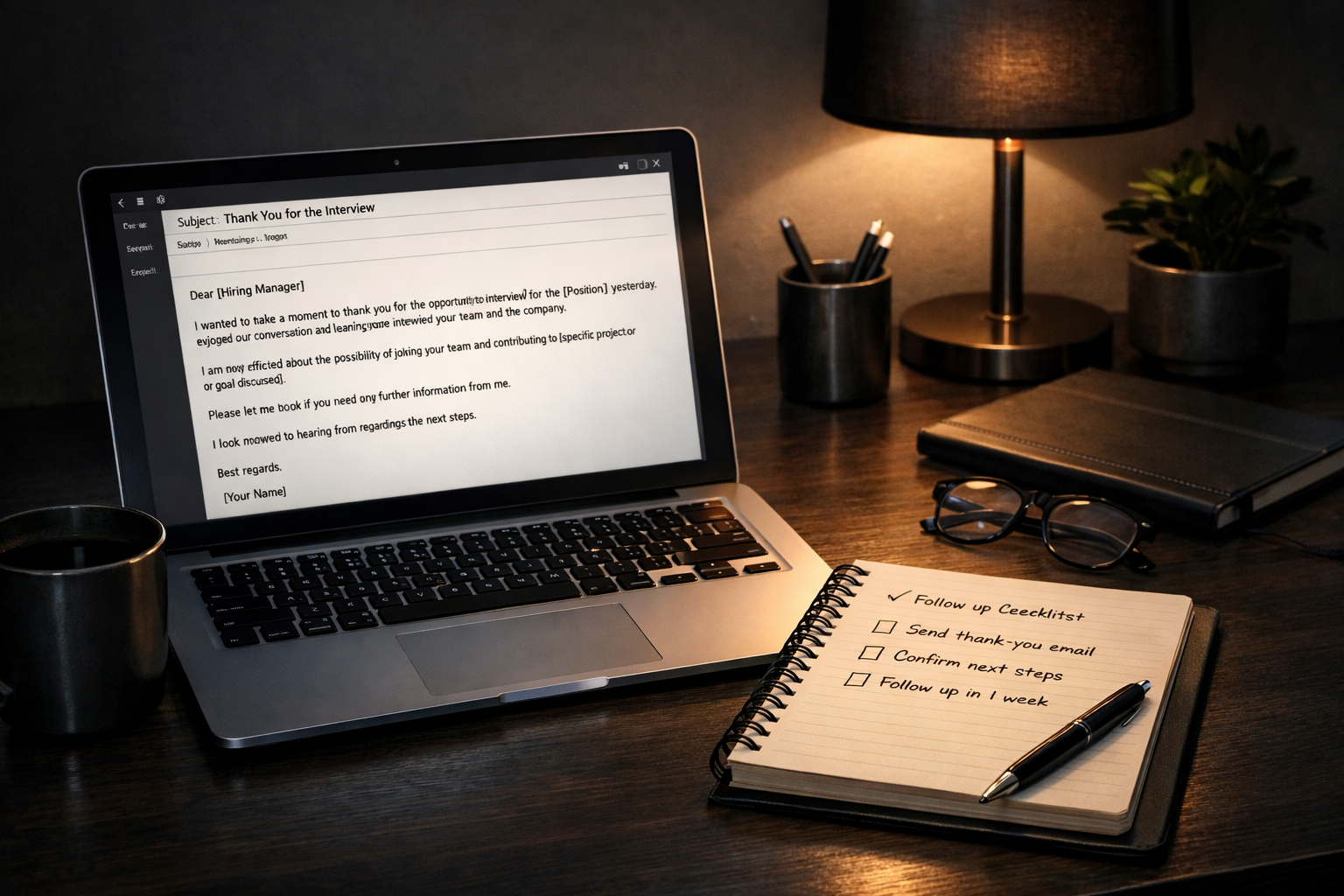
Hi [Name],
Thank you for taking the time to speak with me today about the [Job Title] role. I especially appreciated our discussion about [specific topic]. It was helpful to learn more about how the team is approaching [project, challenge, or goal]. The conversation reinforced my interest in the role, especially because of my experience with [relevant skill or example]. Thanks again, and I appreciate your consideration.
Best, [Your Name]
What makes a note feel strong:
- It sounds like it came from a real conversation.
- It mentions something concrete.
- It restates fit without repeating your entire resume.
- It is easy to scan.
If you interviewed with multiple people, do not send the exact same message to each person. Keep the structure, but change the specific detail. That helps each note feel more genuine and attentive.
If one interviewer asked a tough question and you wish you had answered it better, the thank-you note can help a little. Keep it light. You can say something like, "I also kept thinking about our discussion on X, and I wanted to add that..." Then add one concise point. Do not write a long correction memo.
When the timing changes
There are a few situations where your timing should adjust.
If the interview was part of a fast process Send the note as soon as reasonably possible. If the team is moving quickly, same day is a good option.
If you had a panel interview You can send individual notes the same day or next morning. If you only have the recruiter's email, send one message and ask them to pass along your thanks.
If you forgot to send it Send it anyway. Even if 48 hours have passed, a short, thoughtful note is still worth sending. You do not need a dramatic apology. A simple line like, "I wanted to follow up and thank you for the conversation" is enough.
If it has been several days At that point, make the note more of a combined thank-you and follow-up. Thank them, restate interest, and briefly ask whether they can share any updates on timing.
If the interview was informal or internal Still send one. The tone can be warmer, but the timing rule stays about the same.
If they told you not to follow up Respect that instruction. In that case, skip the thank-you email unless they invited further contact.
Common timing mistakes to avoid
Treat a thank-you note as part of your overall presentation, so avoid these common timing mistakes:
- Waiting too long because you want the perfect wording. Clear and on-time beats polished and late.
- Sending a generic template. If it could be sent to any company, it is too vague.
- Writing too much. A thank-you note is not a second interview.
- Using the wrong name or company. This is one of the easiest ways to look careless.
- Pushing for a response too early. Thank them first. Do not turn the note into a pressure message.
- Adding new information that creates confusion. Keep the message focused and consistent with the interview.
One more practical point: proofread the subject line. A simple option is "Thank you" or "Thank you for today." You do not need anything clever.
Conclusion
Good interview thank-you note timing is simple: send it the same day or within 24 hours when possible. Keep it brief, personal, and easy to read. If you missed that window, send it anyway. A clear follow-up is a professional way to close the loop after an interview.