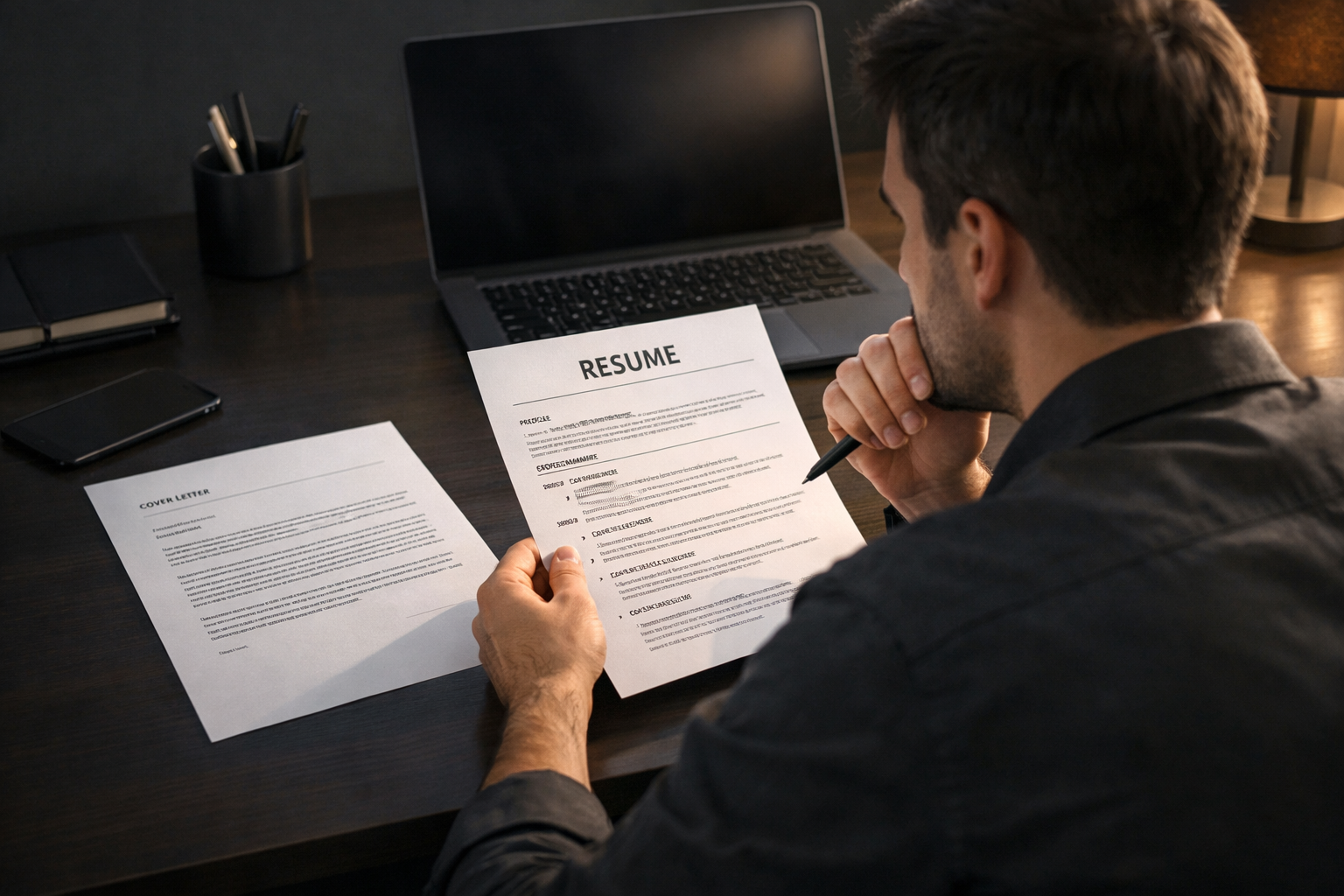
What your cover letter should do that your resume cannot
Think of a resume as a quick-scan document. It usually highlights titles, dates, skills, and results. A cover letter should do a different job: connect the dots.
A useful letter usually answers three questions fast:
- Why this role?
- Why this company or team?
- Why are you a strong fit right now?
That means your letter is not a second resume. It is a short argument.
If your resume says, "Led onboarding redesign that cut ramp time," your cover letter should not say the same thing again with more words. It should explain why that work matters for the target role. For example: "That project taught me how to simplify messy processes for new users, which is one reason this customer education role stands out to me."
That shift matters. You are not just listing what you did. You are showing judgment about what is relevant.
This is also where you can handle things your resume cannot explain well, like a career change, a gap, a move into a new industry, or a strong reason you want this company in particular. Before drafting the letter, make sure the resume itself is solid. This resume audit checklist can help.
What to add instead of repeating bullets
When you feel tempted to restate your resume, use one of these instead.
1. Motivation Say why you want this role now. Keep it grounded. "I am excited about this opportunity" is not enough. "I have spent the last two years working where customer feedback meets product fixes, so a support operations role is a natural next step" is better.
2. Relevance Choose the two or three parts of your background that matter most for this specific job. Ignore the rest. Your letter should be narrower than your resume, not broader.
3. Context A bullet point can show a result without showing the stakes. A cover letter can explain the situation. Were you fixing a broken process? Joining a new team during growth? Rebuilding trust after a service issue? That context makes your work easier to understand.
4. Pattern Instead of presenting one isolated win, use the letter to show a pattern you want the reader to notice. You can do that in a sentence or two: "Across operations and client-facing roles, I have consistently been the person asked to turn loose processes into clear systems."
5. Personal fit This is not about personality adjectives. It is about work style with evidence. Instead of "I am a great communicator," say, "I am used to translating technical issues for non-technical clients, which helped reduce repeat confusion in my last role."
If you mention an achievement that already appears on the resume, add something new. New context. New relevance. New insight. Otherwise, leave it out.
A simple structure that keeps you specific
You do not need a clever opening. A clear structure is enough.
Paragraph 1: State your fit and direction Name the role and the reason it fits your background. One sentence on why the company or team is appealing can help if it is specific.
Example: "I am applying for the Operations Coordinator role because my background in scheduling, client communication, and process cleanup lines up closely with the work you describe. I am especially interested in the role's mix of daily execution and cross-team problem solving."
Paragraph 2: Give one strong example Pick one example from your resume and interpret it. Focus on problem, action, result, relevance.
Example: "In my current role, I rebuilt an intake process that had been causing delays and duplicate work. By tightening the handoff between sales and delivery, I helped shorten turnaround time and reduce avoidable follow-up. That experience feels directly relevant to a role where accuracy and coordination matter every day."
Paragraph 3: Add a second signal or useful context This is a good place for a career change explanation, industry bridge, or another relevant strength.
Example: "Although my recent titles have been in customer support, a consistent part of my work has been operations. I have documented workflows, trained new hires, and spotted issues before they became bigger problems. That is the part of the work I want to deepen in my next role."
Paragraph 4: Close simply Reinforce fit. Thank them. Keep it calm.
Example: "I would welcome the chance to bring that mix of detail, follow-through, and process thinking to your team. Thank you for your time and consideration."
A few rules keep this structure effective:
- Keep the letter focused on the target job, not your full history.
- Use one or two numbers only if they help clarify impact.
- Mirror important job-description language naturally, not mechanically.
- Keep paragraphs short enough to scan.
If your draft feels like a biography, cut it. If it feels like a copy of your resume, rewrite the sentences so they explain meaning, not just activity.
Common mistakes that make the letter feel redundant
The fastest way to weaken a cover letter is to turn it into a paragraph version of the resume. Watch for these traps.
Opening with your life story Lead with relevance first. Save the long backstory.
Repeating every major bullet You do not need to cover each role. One or two well-chosen examples are enough.
Using vague praise "I admire your mission" does not tell the reader much. Point to something real about the role, team, product, or kind of work.
Listing soft skills without proof Words like "hardworking," "passionate," and "team player" carry little weight on their own. Show the behavior behind the trait.
Overexplaining a weak spot If you need to address a gap or pivot, do it briefly and move on to the value you bring now.
Forgetting that the resume and cover letter should work together Your resume should handle scope, chronology, and core keywords. Your cover letter should handle relevance, judgment, and motivation. They should complement each other, not compete.
A good test is this: if you covered the company name and role title, could the letter still apply to ten other jobs? If yes, it is too generic. If you removed the resume, would the letter still give enough proof to feel credible? If no, it needs one stronger example.
Conclusion
Aim for a cover letter that lets the resume show what you have done and uses the letter to explain why it matters here. If you want a stronger base document first, Start my resume or browse the blog for more practical guidance.
FAQ
Short answers for the next obvious questions
Can I mention the same achievement in both the resume and cover letter?
Yes, but add context or relevance. Do not just restate it.
How long should a cover letter be?
Short enough to scan quickly. In practice, 3 to 5 short paragraphs usually works well.
Should I send a cover letter if it is optional?
Send one if it adds something your resume cannot show, like motivation, context, or a career pivot.